The 5 Fights Every Couple Has (And What's Actually Causing Them)

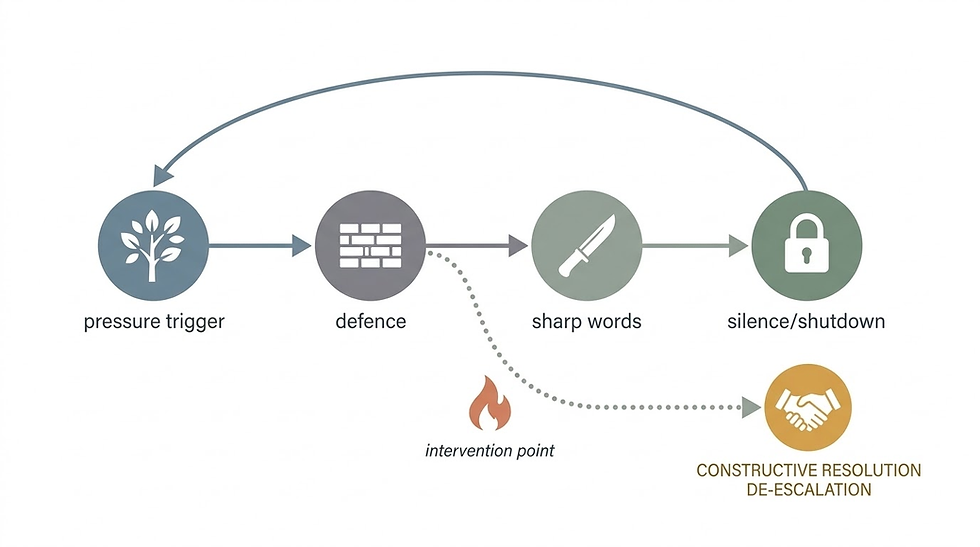
You've had this argument before. Maybe the surface topic was dishes, or money, or someone being — but underneath, it felt exactly like the last three arguments about completely different subjects. Same escalation pattern. Same moment where someone goes quiet. Same two-day recovery. Same return to normal without actually resolving anything.
The topics change. The structure of the fight doesn't.
That's because relationship conflicts aren't primarily driven by the situation. They're driven by the elemental mechanics of how two charts interact under pressure. BaZi maps these mechanics with precision — and the same five structural triggers show up across nearly every pairing.
Fight 1: The Double Silence Lock
What it looks like: A disagreement surfaces. Both people sense it. Neither says anything. Hours. Days. Both are waiting for the other to initiate the conversation. Neither does. The issue doesn't get resolved — it gets buried under the return to normal behaviour.
What's causing it: Two Earth-heavy charts (or any pairing where both people default to absorption over expression) create a dynamic where conflict gets internalised simultaneously by both people. Earth absorbs. When both systems absorb at once, there's nobody left to break the surface tension. This is the most common structural conflict pattern for couples who are otherwise deeply compatible — the compatibility makes the silence comfortable enough to sustain, which is precisely why it's dangerous.
The intervention: Pre-agree on a 24-hour rule. If neither person has initiated after 24 hours, the person who noticed the silence first sends a low-pressure check-in — not "we need to talk," just "thinking of you." This breaks the loop before it compounds.
Fight 2: The Sharp-Tongue Collision
What it looks like: Both people say the technically accurate but emotionally devastating thing. The observation is correct. The delivery is surgical. Both people walk away wounded by the precision of the other's words, feeling simultaneously right and hurt.
What's causing it: Matched Output Stars. When both charts carry Hurting Officer energy (direct, analytical, precision-oriented expression), the communication style is almost identical — which is a strength during good times and a weapon during conflict. Both people cut to the point. Neither softens the delivery. The efficiency that makes daily communication effortless makes conflict communication brutal.
The intervention: Insert a pause before the Metal output stage. When you feel the precise, cutting observation forming in your mind, that's your signal to say: "I need ten minutes before I respond." Water cools Metal. A brief pause converts a scalpel into a considered statement.
Fight 3: The Pacing Argument
What it looks like: One person feels the other is moving too slowly. The other feels they're being rushed. This manifests across everything — relationship milestones, weekend plans, financial decisions, even how quickly someone gets ready to leave the house. The surface complaint is always about the specific situation, but the underlying tension is always about speed.
What's causing it: Elemental climate mismatch. One chart runs warm (forward-moving, decisive, action-oriented) and the other runs cool (deliberate, thorough, assessment-first). Neither pace is wrong. But the warm person interprets coolness as reluctance, and the cool person interprets warmth as pressure. Both feel unheard because they're each translating the other's pace through their own thermal filter.
The intervention: Name the climate gap plainly: "I think I'm running warm and you're running cool right now. I move fast because warmth is how I show care. You move slow because thoroughness is how you show care. Neither of us is wrong."
Fight 4: The Social Friction
What it looks like: Disagreements about social events, mutual friends, how much time to spend with family, or how to present as a couple publicly. It's rarely a dramatic blow-up — more a slow accumulation of subtle resentment around shared social decisions.
What's causing it: Specific branch interactions between the two charts can create what BaZi calls a "harm" relationship — a subtle, grinding friction that operates below the surface. This is different from a direct clash (explosive, obvious, resolved quickly). Harm is erosive. It builds slowly. One person feels the other is dismissive of their social world; the other feels their boundaries aren't respected. The resentment is real but difficult to articulate because no single incident is dramatic enough to justify the emotional weight it carries.
The intervention: Write it down. When the social friction surfaces, don't argue it verbally — share a note or message with your actual position, calmly and specifically. The writing forces precision and removes the heat of the moment. Metal output (structured, written expression) is more productive than Fire output (verbal, heated, reactive) for this particular conflict pattern.
Fight 5: The External Pressure Meltdown
What it looks like: Everything is fine between you — until life gets stressful. Work deadlines, financial pressure, family expectations. Suddenly, you're both irritable, both defensive, and neither of you can be the calm one. The fight isn't about your relationship. It's about external stress that hit both systems simultaneously.
What's causing it: When both charts are under heavy pressure from the same controlling element (typically Wood, which represents external expectations and structure), the pressure impacts both people at the same time. In most pairings, one person absorbs external stress while the other provides stability. But when both charts share the same pressure vulnerability, there's nobody left to anchor the pair. You're both sinking at once and grabbing onto each other for support that neither can provide.
The intervention: Do something physically active together before trying to talk. Cook. Walk. Exercise. Physical activity activates the Fire element, which converts Wood pressure (external stress) into Earth nourishment (grounding, stability). The shared activity creates a bridge that verbal processing can't, because the verbal channel is already overloaded by the same pressure that's causing the conflict.
Why the Same Fights Keep Coming Back
These five patterns aren't situational. They're structural. The dishes and the lateness and the money are surface triggers — the real engine is the elemental interaction between two charts. That's why the same dynamic replays across different topics. You can resolve the topic, but the structural mechanism that produced the conflict is still live, waiting for the next trigger.
A BaZi Compatibility Reading identifies your specific conflict patterns — which of these five are most active in your pairing, what the exact escalation chain looks like, and where the intervention point is for each one. Including mitigation scripts designed for the specific moments your dynamic is most likely to break down.


Comments