"Am I in Love or Just Addicted to the Chaos?"
- Jan 2
- 4 min read
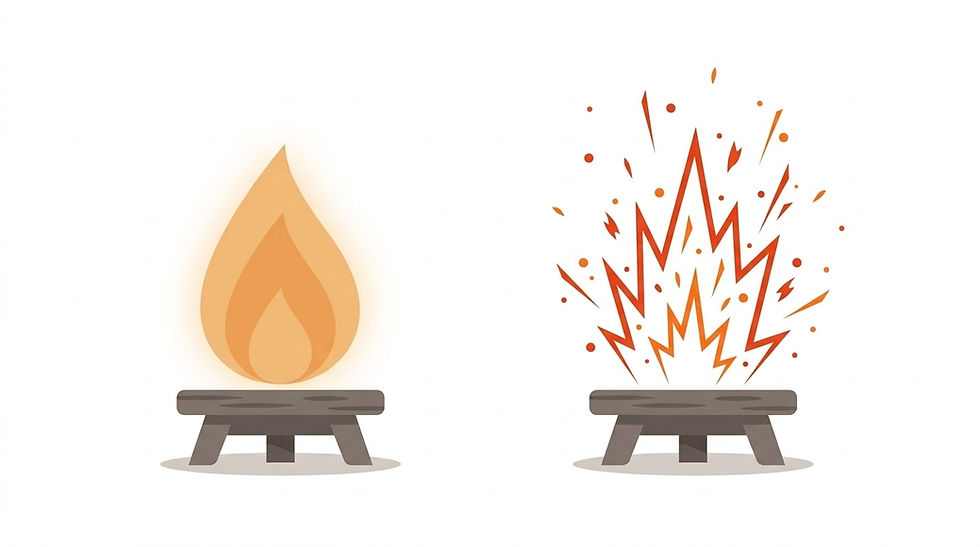
There's a specific feeling that gets mistaken for love constantly. It shows up as a racing pulse when they text back after hours of silence. A sharp focus that makes everything else in your life feel less vivid by comparison. The sensation that this person gets you in a way nobody else has — not because they've said anything particularly insightful, but because the uncertainty itself feels like proof of depth.
That feeling is real. But it might not be what you think it is.
In BaZi, there's a structural mechanism that explains why some people are wired to experience intensity as attraction — and why the pattern keeps running even after you've intellectually decided to stop choosing partners who put you on a rollercoaster. It's called the Seven Killings pattern, and understanding it is the difference between knowing you have a problem and knowing exactly where the switch is.
The Seven Killings Attraction Pattern
In BaZi, every chart contains a position called the Spouse Palace — the structural seat where relationship energy lives. The element sitting in that position determines the baseline frequency of your attraction signal.
For some people, the Spouse Palace contains what's called Seven Killings energy — the element that pressures, controls, and challenges their core Day Master. Seven Killings is not inherently negative. In career contexts, it drives ambition, resilience, and the ability to perform under pressure. But when it sits in the relationship seat, it produces a very specific outcome: your system is factory-wired to feel the strongest pull toward people who keep you slightly off-balance.
This isn't about self-destruction. It's about elemental physics. Your attraction antenna is tuned to a frequency that registers challenge as chemistry. Partners who are stable, predictable, and emotionally safe don't activate the signal strongly enough. Partners who are driven, intense, slightly unpredictable, or hard to fully pin down — they light up the dashboard.
The result is a pattern that looks irrational from the outside but feels absolutely logical from within: you keep choosing people who are exciting and exhausting in equal measure, and you keep confusing the exhaustion for emotional significance.
How to Tell the Difference
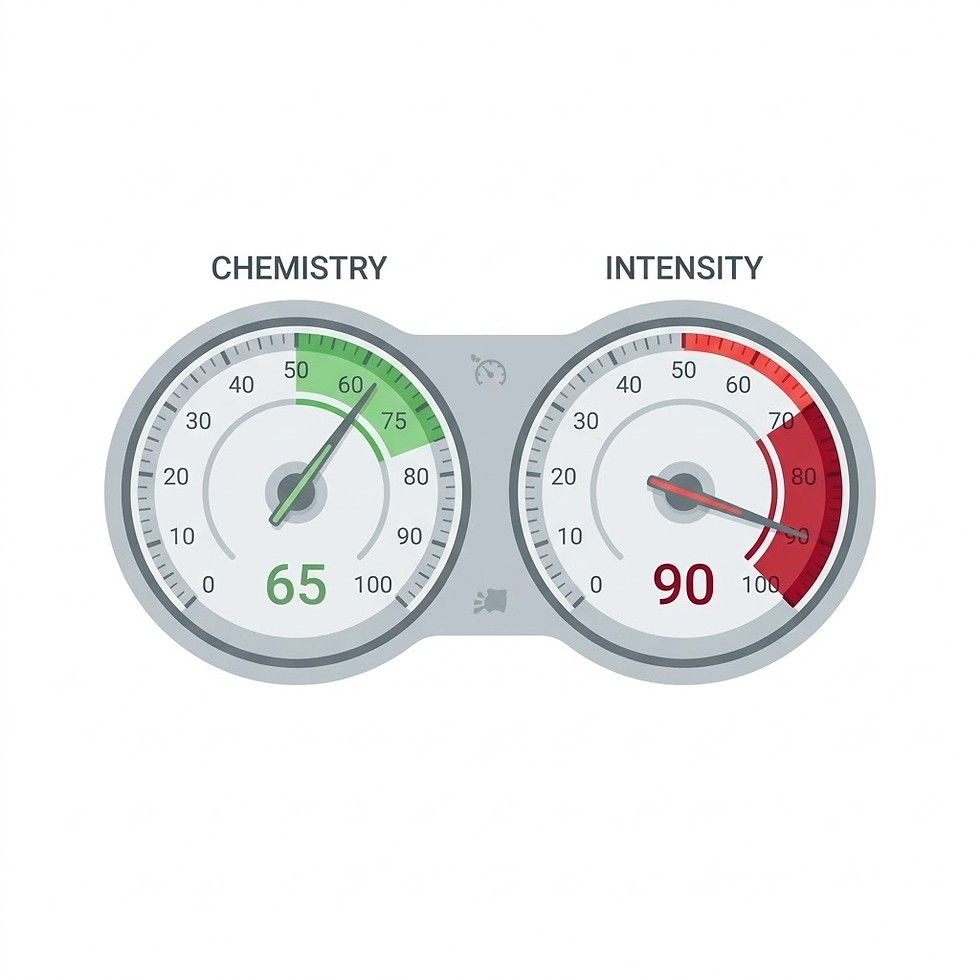
The distinction between genuine chemistry and intensity addiction isn't about the strength of the feeling — both register as powerful attraction. The distinction is about what happens after the initial activation.
Real chemistry builds. The pull is strong at first, and then it deepens as you learn more about the person. Information about them — their values, their consistency, their follow-through — adds to the attraction rather than complicating it. The relationship gets easier to be in over time, not harder.
Intensity addiction cycles. The pull is strong at first, and then it oscillates. Moments of closeness alternate with moments of uncertainty, and the uncertainty is what keeps the engine running. Information about the person — inconsistency, unavailability, mixed signals — doesn't diminish the attraction; it amplifies it. Each cycle of withdrawal and return produces a dopamine hit that your system interprets as deepening connection.
In BaZi terms, this maps directly to the difference between a Spouse Palace that contains a Direct Officer (structured challenge, growth-oriented pressure) versus one that contains Seven Killings (unstructured pressure, intensity without direction). Both produce attraction to challenging partners. But the Direct Officer pattern is attracted to someone who has edge AND follow-through. The Seven Killings pattern, unfiltered, is attracted to the edge itself — regardless of whether anything stable is being built underneath it.
The Filter That Changes Everything
The structural fix is not to override your attraction signal. You can't rewire your Spouse Palace by deciding to "choose better." What you can do is install a secondary filter that runs after the initial attraction fires.
When you feel that electric pull toward someone, ask yourself one question: "Am I attracted to this person, or am I attracted to how uncertain they make me feel?"
If the answer involves the word "uncertain," you're looking at your Seven Killings pattern executing. That doesn't mean the person is wrong for you — but it means the intensity you're feeling is being generated by the dynamic, not by the person's actual qualities. And dynamics based on uncertainty have a structural ceiling: they require the uncertainty to continue in order to sustain the attraction. The moment things stabilise, the feeling fades — and you interpret the fading as falling out of love, when actually it's the pattern losing its fuel source.
The person who is genuinely right for your chart will activate your chemistry AND the stability filter. They'll have the intensity your system requires — because zero edge means zero chemistry for charts wired this way, and that's a specification to work with, not a flaw to fix — but they'll also demonstrate structural follow-through. Plans kept. Words matched with actions. Emotional consistency that doesn't require you to decode mixed signals.
What Your Chart Actually Shows
Your Spouse Palace, your Partner Star element, and your current Luck Pillar together create a complete map of your attraction architecture. The Spouse Palace tells you the baseline pressure setting in your relationship seat. The Partner Star tells you the specific elemental type your system broadcasts for. And your Luck Pillar tells you whether this decade is structurally open for the kind of relationship that lasts — or whether the timing is producing temporary connections that feel significant but don't have the structural support to endure.
A BaZi reading doesn't tell you to stop being attracted to intense people. That would be like telling a compass to stop pointing north. It tells you the exact specification of your attraction wiring, so you can distinguish between the signal (genuine compatibility) and the noise (pattern repetition).
For an individual breakdown of your attraction architecture:
For a cross-chart analysis that shows whether the intensity between you and a specific person is chemistry or pattern:
Learn more about what a compatibility analysis reveals → BaZi Compatibility Reading


Comments