"Why Do I Always Date the Same Type of Person?"
- Dec 27, 2025
- 6 min read

You said you were done with emotionally unavailable partners. You meant it. Then three months later, you're staring at your phone waiting for someone to text back who has the exact same energy as the last person you swore off.
It's not a willpower problem. It's not bad luck. And despite what your therapist friend might suggest, it's not entirely about your attachment style either.
Your attraction pattern is structurally coded — and a system called BaZi (Chinese astrology's Four Pillars of Destiny) can show you exactly what that code looks like, why it keeps executing, and where you actually have room to rewrite it.
Your "Type" Isn't a Preference — It's a Blueprint
In BaZi, every person's birth chart contains a position called the Spouse Palace. It's not about who you marry — it's the structural seat where partnership energy, comfort, and instability show up first. The element sitting in your Spouse Palace determines the baseline frequency your attraction antenna is tuned to.
Here's the part most people don't realise: the Spouse Palace doesn't describe the person you should be with. It describes the person your system is wired to pursue. These are often not the same thing.
Take someone whose Spouse Palace contains Seven Killings energy (the element that pressures and controls their Day Master). This person is factory-set to feel the strongest pull toward partners who challenge them — driven, intense, slightly unpredictable, never boring. Comfort-first partners feel flat to this system. The person knows, intellectually, that stability would be healthier. But their elemental wiring fires hardest on edge.
Now take someone whose Spouse Palace is the same element as their own Day Master — Earth sitting on Earth, for instance. This person's relationship seat is self-contained and comfortable. They default to "I'm fine on my own" in partnerships. They're patient, steady, and not easily rattled by slow progress. But hidden inside that comfortable palace, there might be a buried attraction to challenge — the desire for someone who disrupts the comfort zone, but only after trust is established.
Neither of these is broken. They're different specs. The problem isn't the wiring — it's not knowing the wiring exists, so you keep running the same programme without understanding what's driving the output.
Why the Same Pattern Repeats
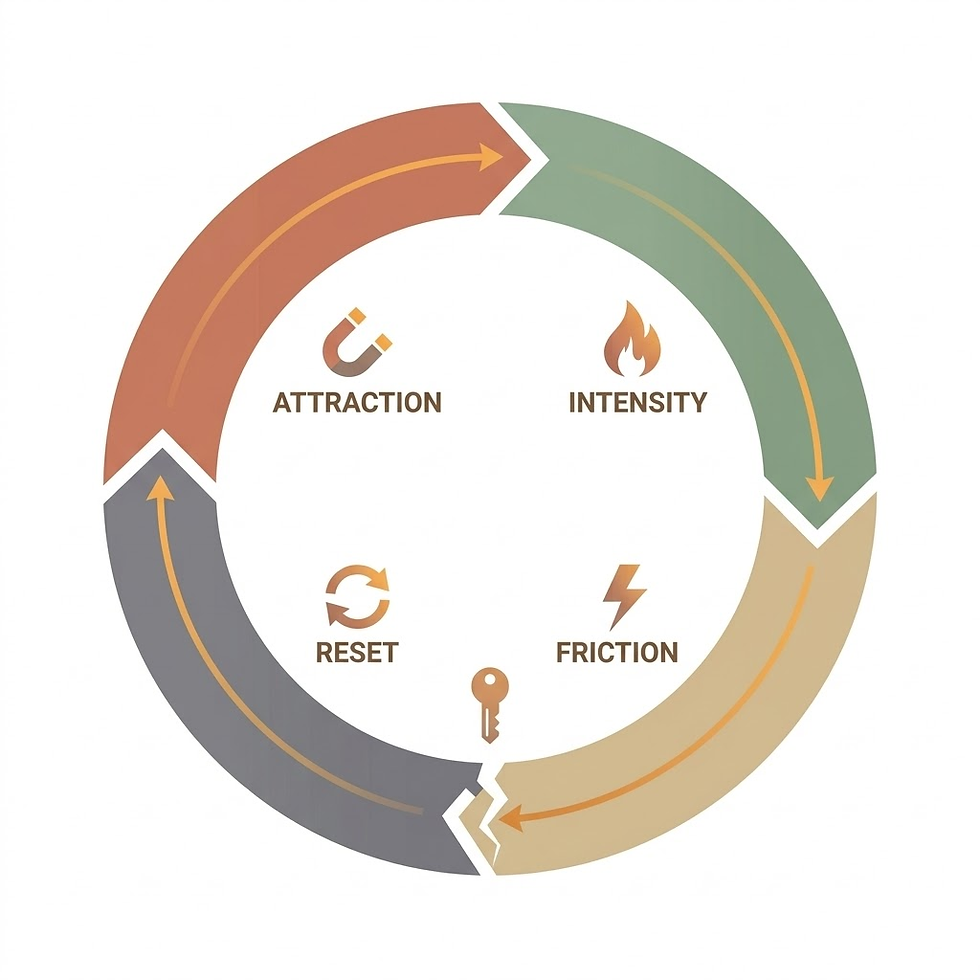
There are three structural reasons your dating history looks like a playlist stuck on repeat:
Your Partner Star is element-specific. In BaZi, the element your chart is coded to seek in a partner is determined by your Day Master. For a male Earth Day Master, the partner archetype is Water — someone fluid, emotionally intelligent, and capable of filling the gaps in a dry structure. For a female Earth Day Master, the partner archetype is Wood — someone who challenges, provides structure through pressure, and pushes growth. These aren't suggestions. They're the elemental frequency your attraction signal broadcasts on. You literally notice people who carry this element more readily than others.
Your chemistry trigger has a set threshold. BaZi can map your chemistry trigger intensity — how fast and how hard your attraction fires when the right elemental signal appears. Some charts have a trigger score in the 80s: fast ignition, strong directional pull, immediate certainty. Others sit in the 50s: slow burn, gradual recognition, attraction that builds over repeated exposure. If your trigger is high and your Spouse Palace carries pressure energy, you will experience intense, fast attraction to people who are intense and fast — and you'll interpret that intensity as proof of connection, when it may actually be proof of pattern.
Your communication wiring creates the same exit point. Many charts contain a structural mechanism where the expressive output star (the channel through which you articulate feelings) gets bound or suppressed under emotional pressure. If your expression channel goes offline every time things get serious, you'll hit the same wall in every relationship — not because the other person is wrong, but because your verbal channel keeps cutting out at the exact moment it's most needed. The relationship doesn't fail because of compatibility. It fails because of a communication short-circuit that was active before this partner and will be active after them.
The Filter You're Missing
The fix isn't to override your attraction pattern. Suppressing your wiring doesn't work — you'll either choose someone you're not genuinely drawn to (which creates a different set of problems) or you'll white-knuckle it until the pattern reasserts itself.
The fix is to add a secondary filter on top of your existing attraction signal.
Your Spouse Palace and Partner Star tell you who activates your system. That part isn't changing. What you can change is what you do with the information after the activation fires. Specifically:
Does this person carry the intensity your chart is wired for AND the structural follow-through that sustains a relationship beyond the initial pull? Intensity without reliability is addiction. Reliability without intensity is friendship. Your chart can tell you which side of that equation you habitually overweight.
Is your current Luck Pillar actually open for commitment? BaZi maps your life into 10-year phases, each governed by a different elemental energy. Some decades are structurally primed for relationship formation — the partner star becomes active, the commitment pressure increases, the conditions for meeting and recognising a long-term match are mechanically live. Other decades are about career, health, or internal development. Forcing a relationship commitment during a decade that's structurally oriented elsewhere doesn't mean it will fail — but it means you're building against the grain, and you need to know that.
What This Looks Like in Practice
Consider two people who share the same Day Master (both Yin Earth). One runs warm and dry — driven, forward-moving, quick to act. The other runs cool and wet — deliberate, measured, cautious with trust.
On paper, you might think they're too similar. In BaZi terms, they're a climate complement — each carrying exactly the element the other's system is missing. The warm one brings activation energy that thaws the cautious one's guard. The cool one provides the moisture and reflection that prevents the warm one from overheating.
But their Spouse Palaces tell a different story. The warm one's relationship seat is comfortable and self-contained — closeness feels natural but not urgent. The cool one's relationship seat is inherently tense — closeness triggers a security scan before it triggers warmth. So the talking stage stalls. Not because either person lacks interest, but because their pacing architectures are structurally misaligned, and neither knows why the other is moving at a different speed.
A BaZi Compatibility Reading identifies this exact dynamic and gives both people the mechanical explanation — plus specific scripts for bridging the gap. The warm one learns to be consistently present without being pushy. The cool one learns that their slowness isn't a flaw but a security protocol that needs to complete before trust releases.
This is what a BaZi Compatibility Reading decodes — the structural mechanics underneath the chemistry, and the operating manual for making it work.
Breaking the Loop
Your pattern isn't your destiny. But it is your default setting, and defaults run automatically unless you consciously intervene.
Three things you can do right now, before you get any kind of reading:
Map your last three. Write down the last three people you were genuinely drawn to. Not people you dated out of convenience — people who made your pulse shift. Note what they had in common. Not surface traits like appearance or profession. Elemental traits: were they intense or calm? Structured or chaotic? Emotionally available or slightly out of reach? The pattern that emerges is your Partner Star expressing itself.
Identify your exit point. Where did each of those connections break down? The same stage every time — the vulnerability conversation, the commitment question, the first real conflict? That recurring exit point is almost certainly a structural mechanism in your chart, not a coincidence.
Ask the pacing question. In your most recent connection, were you the one running hot or the one holding back? And did the other person's pace create attraction or anxiety? The answer tells you something about your Spouse Palace's default setting.
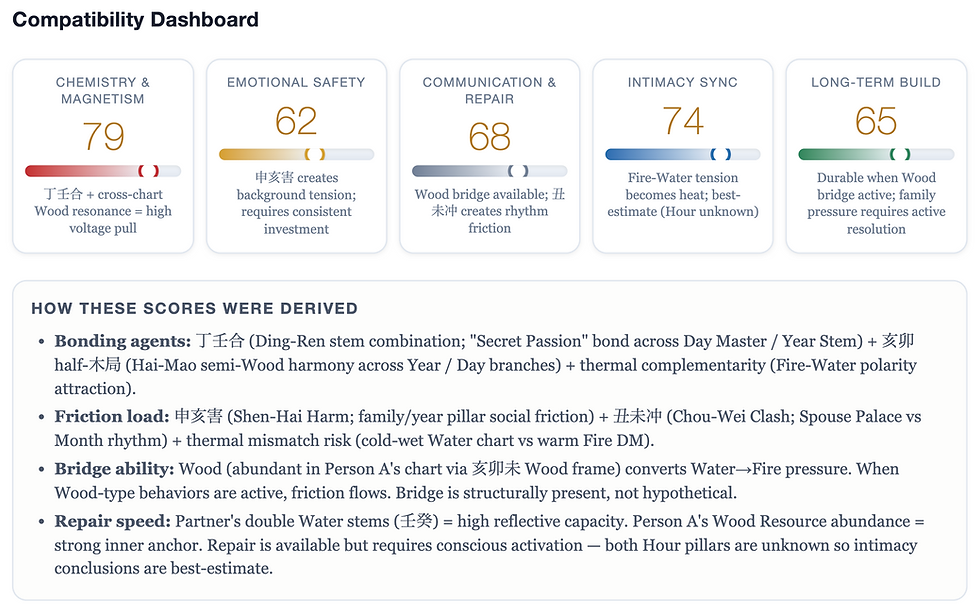
If you want the full structural map — your Spouse Palace, Partner Star, chemistry trigger score, communication wiring, and the specific patterns your chart is coded to repeat — a BaZi reading gives you that in black and white.
For couples who want the cross-chart analysis — attraction mechanics, conflict wiring, pacing architecture, and mitigation scripts for your specific dynamic:


Comments